

How to Choose the Right Downlight for Your Project
How to Choose the Right Downlight for Your Project
Choosing the right downlight isn’t just about brightness—it’s about how the fixture installs, how it looks once it’s in the ceiling, and how it performs in the space. Whether you’re lighting a home, a condo, or a full commercial build, understanding the differences between downlight types makes it easier to specify the right solution the first time.
This guide breaks down three popular downlight styles—SDL Slim Wafer, SSM Slim Surface Mount, and CDL03 Commercial Downlight—and explains when each one makes the most sense for your project.
Understanding the Basics: What Really Differentiates Downlights?
When comparing downlights, a few factors matter most:
Installation method (flush, surface-mounted, or recessed)
Ceiling and wiring conditions
Voltage and dimming requirements
Glare control and aesthetics
Cost vs performance expectations
Some downlights overlap heavily in application, while others are designed specifically for higher-spec commercial environments.
Slim Recessed Downlights (SDL Series)
Flexible, flush, and budget-friendly
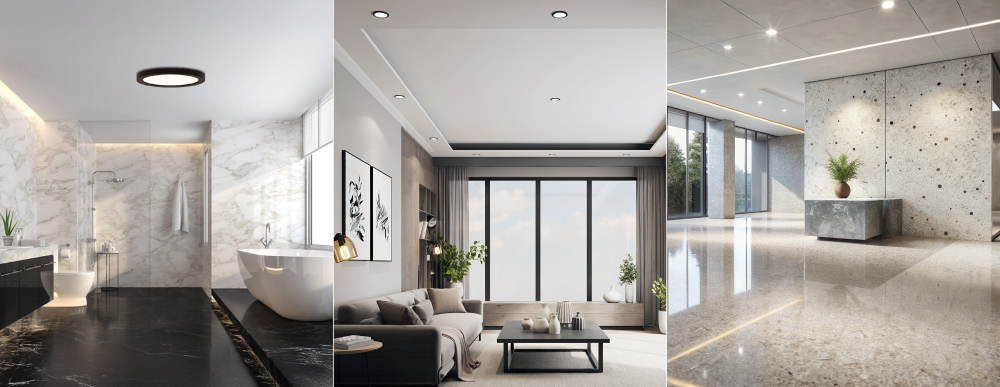
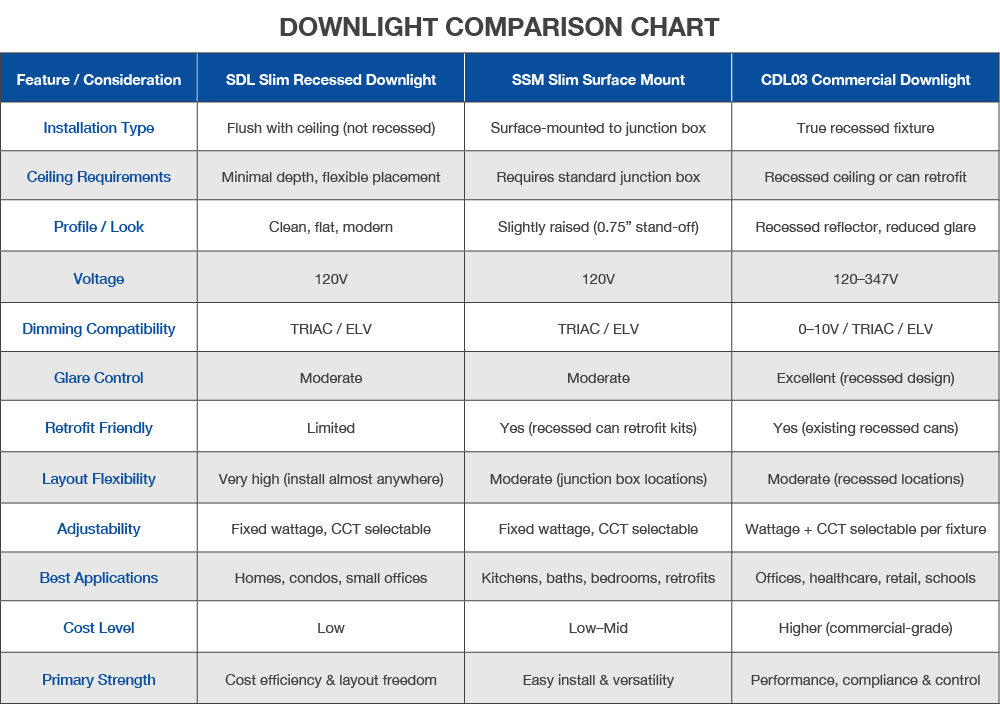
Our SDL series Slim Recessed Downlights are one of the most adaptable lighting options available. They sit flush and parallel with the ceiling but are not fully recessed, making them ideal when ceiling depth is limited or flexibility is needed.
Where our SDL Slim Recessed Downlights Work Best
Homes, condos, and apartments
Small offices and light commercial spaces
Projects requiring flexible fixture placement
Because Slim Recessed Downlights don’t rely on junction box placement, they can be installed almost anywhere on the ceiling—as long as power is available—making custom layouts easy to achieve.
Key Benefits
Budget-friendly solution
Clean, flush ceiling appearance
Flexible placement for custom layouts
120V compatible with standard TRIAC / ELV dimmers
Choose our SDL series when: you want a low-cost, modern downlight with maximum placement flexibility and a minimal visual profile.
Slim Surface Mounts (SSM Series)
Easy installation with maximum versatility
Slim Surface Mounts are often compared directly with Slim Recessed Downlights because they serve many of the same residential and light commercial applications. The biggest difference comes down to installation method and appearance.
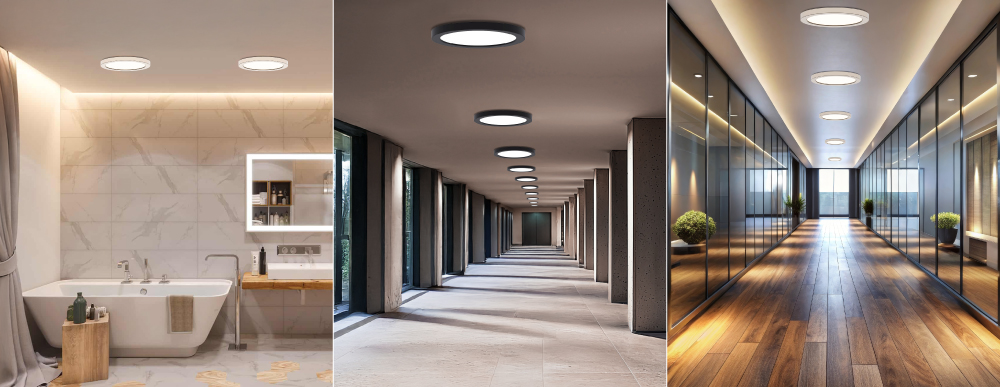
SSM fixtures mount directly to a standard junction box and sit slightly off the ceiling with a subtle 0.75” stand-off, giving them a refined surface-mount look.
Where our SSM series Slim Surface Mounts Work Best
Kitchens, bathrooms, bedrooms, dining rooms
Renovations with existing junction boxes
Retrofit projects using recessed can kits
Slim Surface Mounts are especially useful when you want a simple installation process or are upgrading existing fixtures without opening ceilings.
Key Benefits
Mounts directly to standard junction boxes
Can retrofit into existing recessed cans
Available in multiple sizes for different spaces
120V compatible with TRIAC / ELV dimmers
Choose our SSM series when: ease of installation, retrofit capability, and multi-room versatility matter more than a fully flush look.
Commercial Downlights (CDL03 Series)
Engineered for performance-driven commercial spaces
Our CDL03 series offers a true commercial downlight, designed for environments where performance, compliance, and control matter more than cost alone. Unlike SDL and SSM, the CDL03 is a fully recessed fixture with a reflector, helping reduce glare and improve visual comfort.
Where CDL03 Works Best
Offices and corporate spaces
Healthcare and educational facilities
Retail environments
Large-scale commercial projects
Its ability to support 120–347V and multiple dimming protocols makes it suitable for a wide range of commercial electrical systems.
Key Benefits
True recessed design for glare reduction
120–347V compatibility
Supports 0–10V, TRIAC, and ELV dimming
IC-rated and airtight for code compliance
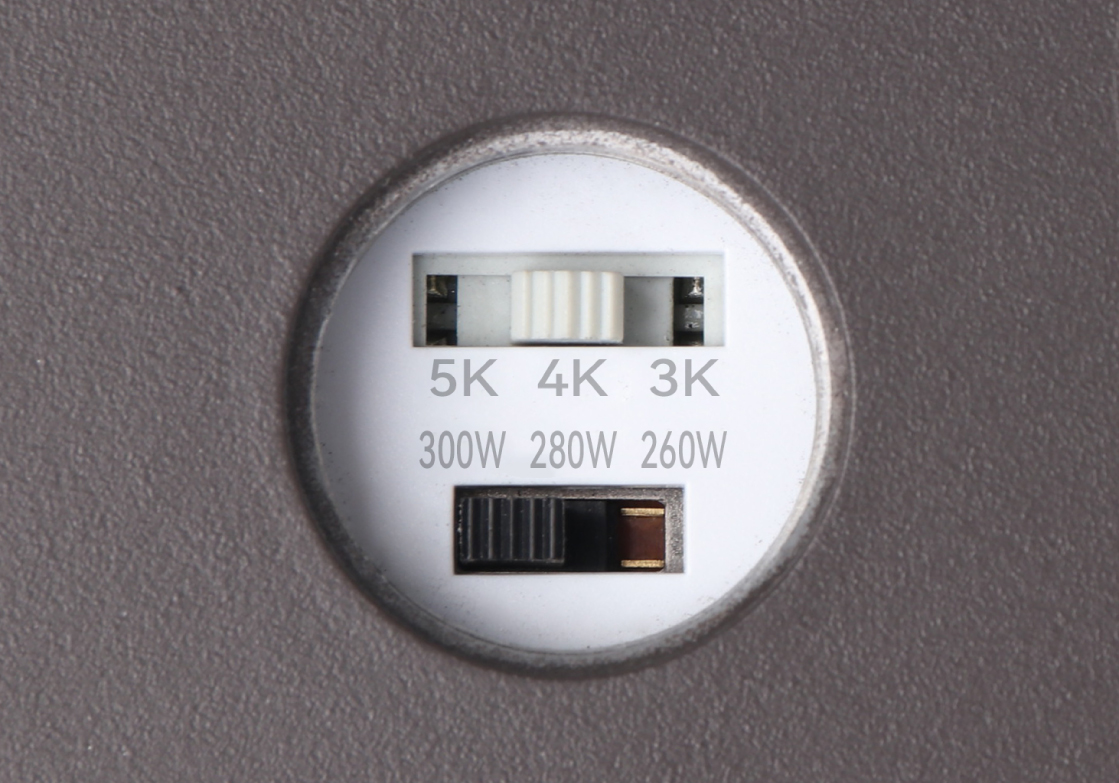
Multiple wattage and CCT options per fixture for on-site tuning
Choose our CDL03 series when: you need commercial-grade performance, glare control, and flexibility across voltage and dimming systems.
Final Takeaway
There’s no one-size-fits-all downlight. SDL and SSM provide cost-effective, modern solutions for most residential and light commercial spaces, with the choice often coming down to installation preference and aesthetics. CDL03 steps in when projects demand commercial compliance, glare control, and electrical flexibility.
Understanding how each downlight is designed to perform ensures your lighting solution fits both the space and the project requirements—without over- or under-specifying.