


FL05 Area Lights vs FLF Flood Lights
FL05 Area Lights vs FLF Flood Lights
When lighting outdoor spaces, choosing the right fixture is just as important as choosing the right output. While LED area lights and LED flood lights may look similar at a glance, they are engineered for different purposes. Understanding how optics, distribution, and mounting work together is the key to achieving safe, efficient, and responsible lighting.
This guide breaks down the difference between FL05 Area Lights and FLF Flood Lights, explains how optics are meant to be used, and shows where each fixture performs best, along with common mistakes to avoid.
What an LED Area Light Is Designed to Do (FL05)
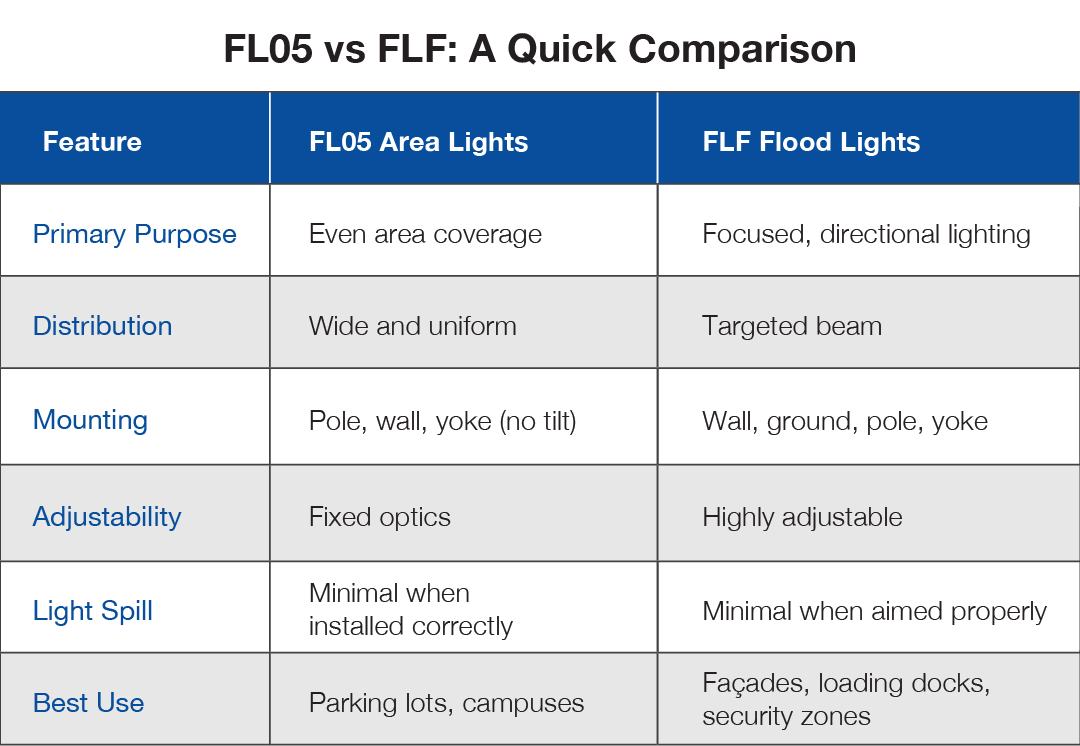
An LED area light is engineered to illuminate large outdoor spaces evenly from above. FL05 fixtures are typically installed horizontally with LEDs parallel with the ground.
How the FL05 Lights an Area
Wide, uniform distribution
Carefully shaped optics which follow industry standard distribution types
Light directed toward the ground, not outward or upward
Think of it as a night time skylight—designed to blanket an area smoothly and comfortably creating uniform lighting.
Why FL05s Should be Parallel with the Ground
The distribution types used in area lights are not designed for tilt. Tilting an FL05 changes how the optics function and causes:
Significant light spill and uplight
Reduced light levels on the ground
Increased glare
Loss of uniform IES distribution
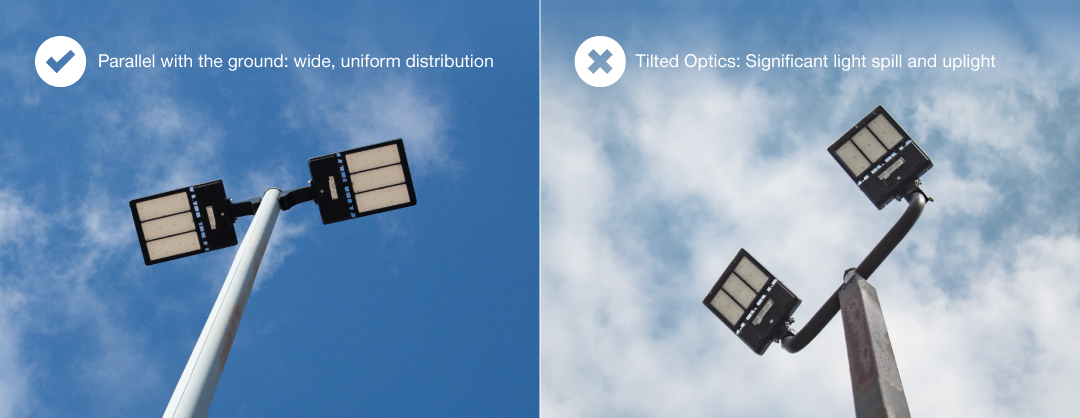
When installed parallel with the ground, using the fixed mount, the FL05 delivers light exactly where it’s intended—on walkways, pavement, and task areas.
DarkSky & Light Pollution Benefits
Downward-facing FL05s help reduce light pollution by preventing wasted uplight. When installed with the fixed mount and set to 3000K, FL05 fixtures are DarkSky approved, supporting responsible outdoor lighting while maintaining visibility and safety.
What an LED Flood Light Is Designed to Do (FLF)
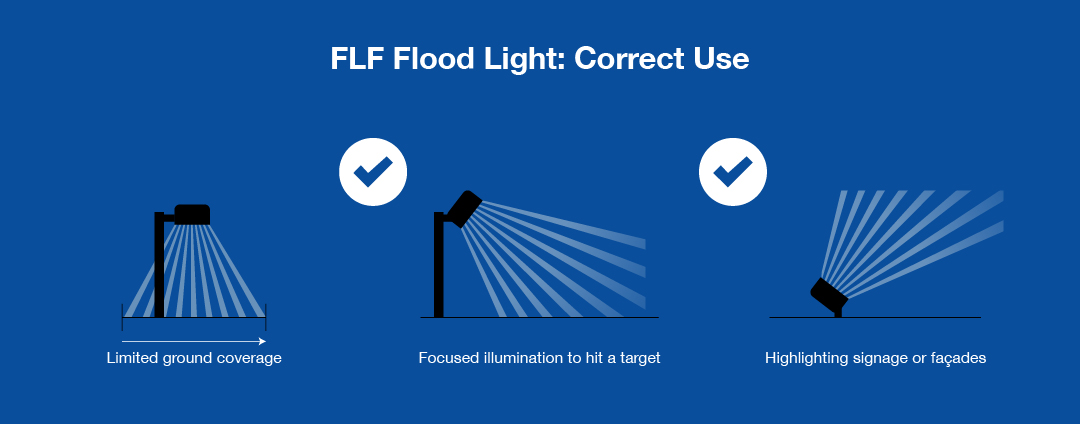
An LED floodlight is a directional fixture built to illuminate a specific target. FLF fixtures are intended to be installed with tilt, allowing the LEDs to face the object or zone being lit.
How the FLF Lights a Target
Medium to wide beam spreads
Strong directional output
Light goes where it’s aimed—nowhere else
Think of it like a high-powered flashlight mounted to a building: focused, adjustable, and purposeful.
Why Flood Lights Excel at Focused Illumination
Flood lights use beam angle control rather than area distribution. This allows them to:
Minimize light spill
Efficiently throw light over distance
Highlight specific zones without over-lighting the site
Responsible floodlight use can actually reduce light pollution by focusing light only where needed.
Real-World Applications: Where Each Fixture Belongs
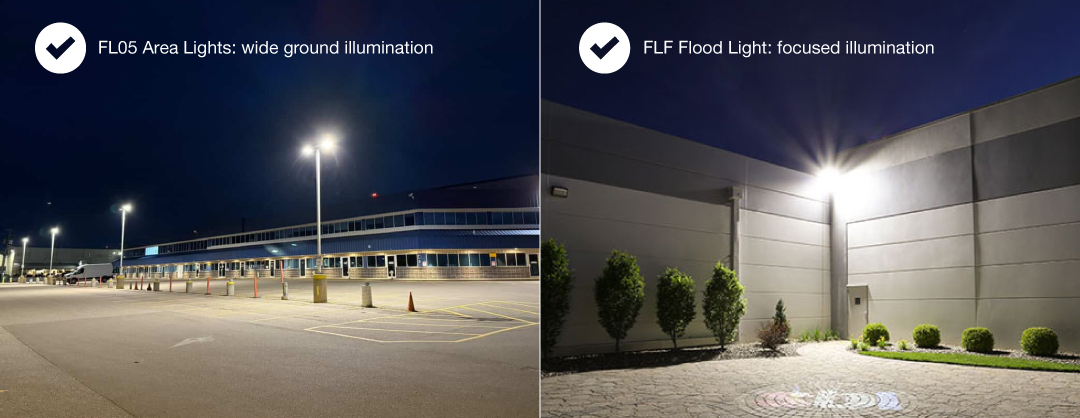
Use FL05 Area Lights When:
Lighting parking lots
Covering warehouse yards
Lighting large campuses or commercial properties
The goal is consistent visibility, safety, and comfort across a wide area.
Use FLF Flood Lights When:
Lighting building exteriors
Securing loading docks
Illuminating sports fields
Highlighting signage or façades
The goal is focused illumination without lighting the entire site.
A Common (and Correct) Lighting Strategy
Many properties benefit from using both fixtures together:
FL05 area lights for general site lighting
FLF floodlights for corners, loading zones, or building faces
This layered approach delivers uniform coverage while maintaining control and efficiency.
Using FL05 the Wrong Way (What to Avoid)
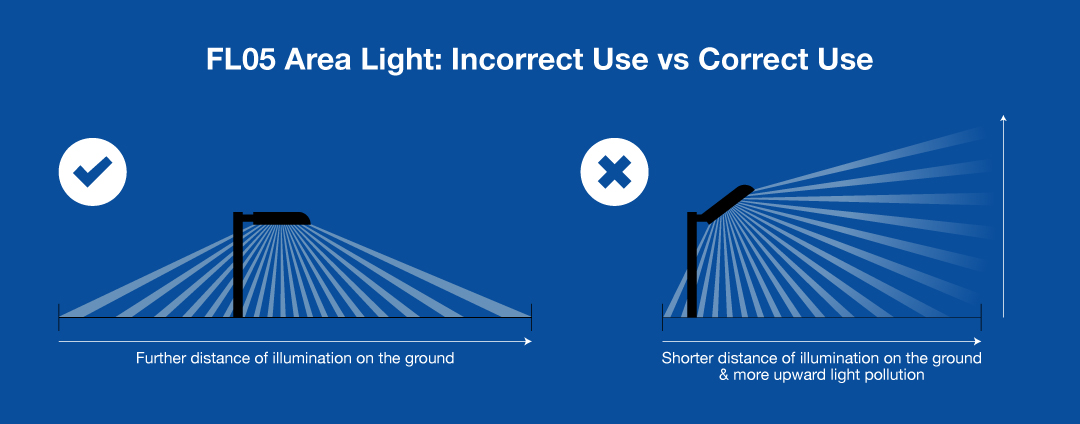
Tilting an FL05 to “reach farther” often backfires:
Light is pushed upward instead of outward
Ground illumination is reduced
Glare and light pollution increase
Energy is wasted
Using FLF the Right Way
Flood lights are designed to tilt—this is where they shine.
Lighting Areas with Intention
The difference between an area light and a flood light isn’t just mounting—it’s intent. FL05 area lights rely on optics and downward orientation to create safe, uniform environments with minimal light pollution. FLF flood lights rely on beam control and adjustability to deliver precise, targeted illumination.
Choosing the right fixture—and using it as designed—results in better visibility, lower energy waste, reduced light pollution, and a more responsible lighting solution overall.


'%20d='M34.017,41.99l-20,0.019c-4.4,0.004-8.003-3.592-8.008-7.992l-0.019-20%20c-0.004-4.4,3.592-8.003,7.992-8.008l20-0.019c4.4-0.004,8.003,3.592,8.008,7.992l0.019,20%20C42.014,38.383,38.417,41.986,34.017,41.99z'/%3e%3cradialGradient%20id='yOrnnhliCrdS2gy~4tD8mb'%20cx='11.786'%20cy='5.54'%20r='29.813'%20gradientTransform='matrix(1%200%200%20.6663%200%201.849)'%20gradientUnits='userSpaceOnUse'%3e%3cstop%20offset='0'%20stop-color='%234168c9'/%3e%3cstop%20offset='.999'%20stop-color='%234168c9'%20stop-opacity='0'/%3e%3c/radialGradient%3e%3cpath%20fill='url(%23yOrnnhliCrdS2gy~4tD8mb)'%20d='M34.017,41.99l-20,0.019c-4.4,0.004-8.003-3.592-8.008-7.992l-0.019-20%20c-0.004-4.4,3.592-8.003,7.992-8.008l20-0.019c4.4-0.004,8.003,3.592,8.008,7.992l0.019,20%20C42.014,38.383,38.417,41.986,34.017,41.99z'/%3e%3cpath%20fill='%23fff'%20d='M24,31c-3.859,0-7-3.14-7-7s3.141-7,7-7s7,3.14,7,7S27.859,31,24,31z%20M24,19c-2.757,0-5,2.243-5,5%20s2.243,5,5,5s5-2.243,5-5S26.757,19,24,19z'/%3e%3ccircle%20cx='31.5'%20cy='16.5'%20r='1.5'%20fill='%23fff'/%3e%3cpath%20fill='%23fff'%20d='M30,37H18c-3.859,0-7-3.14-7-7V18c0-3.86,3.141-7,7-7h12c3.859,0,7,3.14,7,7v12%20C37,33.86,33.859,37,30,37z%20M18,13c-2.757,0-5,2.243-5,5v12c0,2.757,2.243,5,5,5h12c2.757,0,5-2.243,5-5V18c0-2.757-2.243-5-5-5H18z'/%3e%3c/svg%3e)

