

From Metal Halide to LEDs: The Evolution of Sports Lighting
From Metal Halide to LEDs: The Evolution of Sports Lighting
Sports lighting has evolved far beyond simply illuminating a field at night. Today’s systems are designed to improve visibility, enhance safety, support broadcasting, reduce energy consumption, and minimize light pollution—all while creating a better experience for players and spectators alike.
From large stadiums to community courts and golf courses, modern LED lighting has transformed how sports spaces are designed and used.
The Early Days of Sports Lighting
The first experiments with sports lighting began shortly after the invention of the incandescent lamp in the late 1800s. Early systems were dim, inconsistent, and impractical for large-scale events, but they introduced the idea of extending sports beyond daylight hours.
By the 1920s and 1930s, powerful floodlights made nighttime sports much more viable. One of the most significant milestones came in 1935 with the first Major League Baseball night game, helping establish sports lighting as an essential part of modern athletics.
The Rise of Metal Halide & HID Lighting
From the 1950s through the early 2000s, metal halide and HID lighting became the standard for stadiums and outdoor sports facilities. These systems delivered higher output and improved efficiency compared to earlier technologies, making them suitable for large playing surfaces.
However, they also introduced challenges:
High energy consumption
Long warm-up times
Frequent maintenance
Inconsistent light levels and glare
As sports facilities evolved, so did the demand for better-performing lighting solutions.
The LED Revolution
LED technology completely changed the sports lighting industry. Modern LED systems provide:
Instant-on performance
Reduced energy consumption
Longer fixture lifespan
Improved visibility with fewer shadows and less glare
Better optical control and uniformity
These improvements have made LEDs the preferred solution for a wide range of sports applications—from professional venues to local recreation spaces.
LED lighting also supports modern broadcasting requirements with flicker-free illumination and consistent colour performance, helping improve both live viewing and high-definition video capture.
Lighting Different Types of Sports Facilities
Modern sports lighting isn’t one-size-fits-all. Different environments require different approaches to illumination, visibility, and light control.
Large Sports Facilities & Stadiums
Large venues require high-output lighting capable of covering wide playing surfaces while maintaining consistent illumination levels.
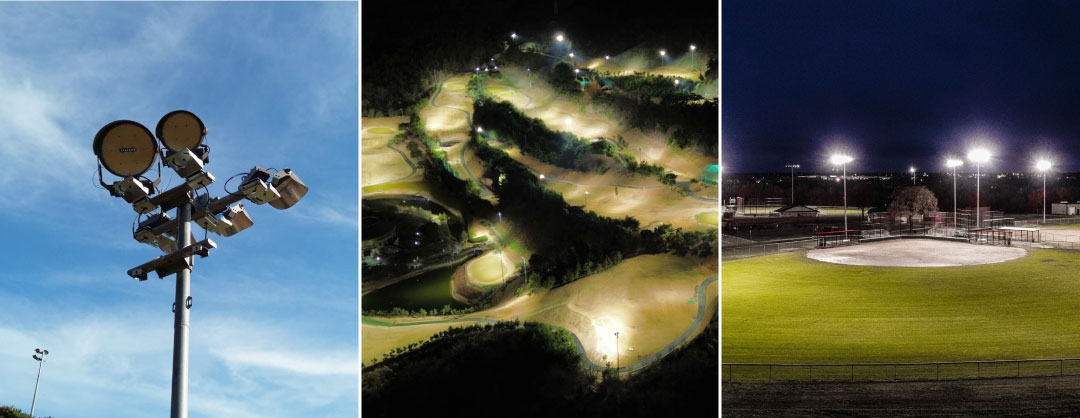
Titan Sports Lights are designed for these demanding applications, delivering powerful, reliable illumination for:
Sports stadiums
Outdoor athletic fields
Recreational complexes
High-ceiling sports facilities
Their high-output performance and durability also make them ideal for golf courses and driving ranges, where broad, uniform coverage is essential for visibility across large open areas.
Community Courts & Neighbourhood Recreation Areas
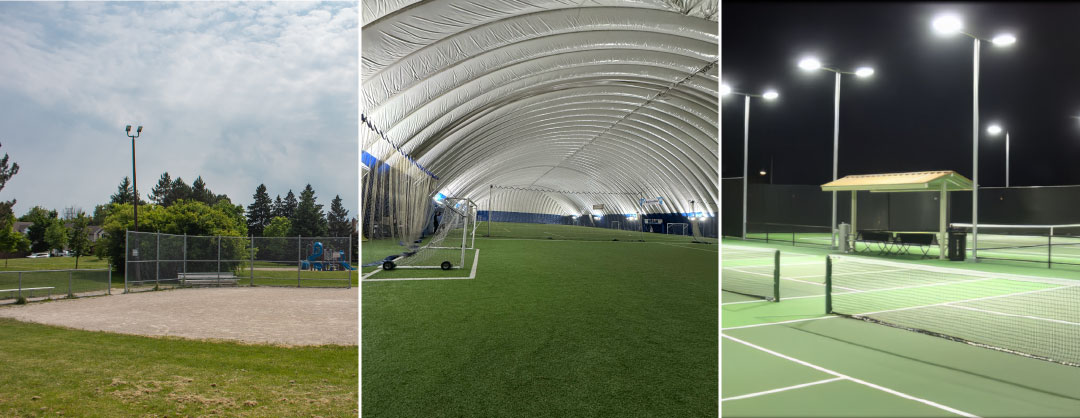
Smaller outdoor courts, such as basketball and tennis courts, can require a different lighting approach. In residential or community settings, controlling glare and reducing light spill becomes especially important.
This is where fixtures like the FL05 Flood Light provide an effective solution. With proper configuration, these fixtures deliver even illumination across the playing surface while helping reduce unnecessary light pollution.
When set to 3000K and paired with a fixed mount, the FL05 series is DarkSky approved, supporting more responsible outdoor lighting practices for neighbourhood and community environments.
The Future of Sports Lighting
The evolution of sports lighting continues to focus on performance, efficiency, and environmental responsibility. Modern LED systems not only improve visibility and safety, but also help facilities reduce operating costs and minimize environmental impact through better optical control and energy efficiency.
As sports environments continue to evolve—from professional stadiums to local community courts—lighting plays an increasingly important role in shaping the experience for athletes, spectators, and surrounding communities alike.
Lighting Built for Modern Sports Spaces
Today’s sports facilities need lighting solutions that balance performance, reliability, efficiency, and responsible light distribution.
Whether illuminating a stadium, golf facility, or neighbourhood court, modern LED technology allows spaces to remain functional, visually comfortable, and energy efficient long after the sun goes down.