

Linear vs. Round High Bays: Which Is Right for Your Project?
Linear vs. Round High Bays: Which Is Right for Your Project?
When selecting high bay lighting, one of the most common questions is: Should I choose a linear or round fixture?
While both styles are widely used across commercial and industrial applications, the differences between them have evolved, especially with modern LED technology.
In this guide, we’ll break down the key differences between linear and round high bays and help you determine which option best suits your space.
Watch the Full Video Explanation
Prefer a quick walkthrough? Watch our full video below for a detailed comparison:
How High Bays Have Evolved
Traditionally, linear high bays were designed around fluorescent lamp technology. Fixtures were typically built in standard lengths—most commonly 4 feet—and light output depended on:
The number of lamps
Lamp type
Reflector design
These factors determined both brightness and light distribution.
With LED technology, things have changed.
Instead of relying on lamps and reflectors, modern fixtures use optics to shape and direct light exactly where it’s needed. This means the shape of the fixture no longer determines the light distribution.
What Linear and Round High Bays Have in Common
Modern high bays—like our HB8 Round High Bay and LHB04 Linear High Bay—share more similarities than differences.
Adjustable Light Distribution
Both fixtures offer interchangeable optics, allowing you to tailor lighting for:
Narrow aisles
Open warehouse spaces
Retail environments
Smart Controls Compatibility
Both series support:
Twist-in motion sensors
The same remote control system for easy programming
Emergency Backup Options
Both can be equipped with battery backup, ensuring continued illumination during power outages.
Durable Construction
Die-cast aluminum housing
Operating temperatures from -40°C to 50°C
Pre-installed power and dimming cables for easier installation
In short: performance is no longer dictated by shape alone
What Sets Them Apart?
If performance features are similar, what actually differentiates linear and round high bays?
1. Environmental Ratings & Certifications
This is one of the most important deciding factors.
Round High Bay (HB8)
IP65 (wet location rated)
NEMA 4X
NSF certified
Ideal for:
Washdown environments
Food processing facilities
Damp or dusty locations
Linear High Bay (LHB04)
IP20 (dry location only)
No additional certifications
Best suited for:
Warehouses
Retail spaces
Indoor facilities with controlled environments
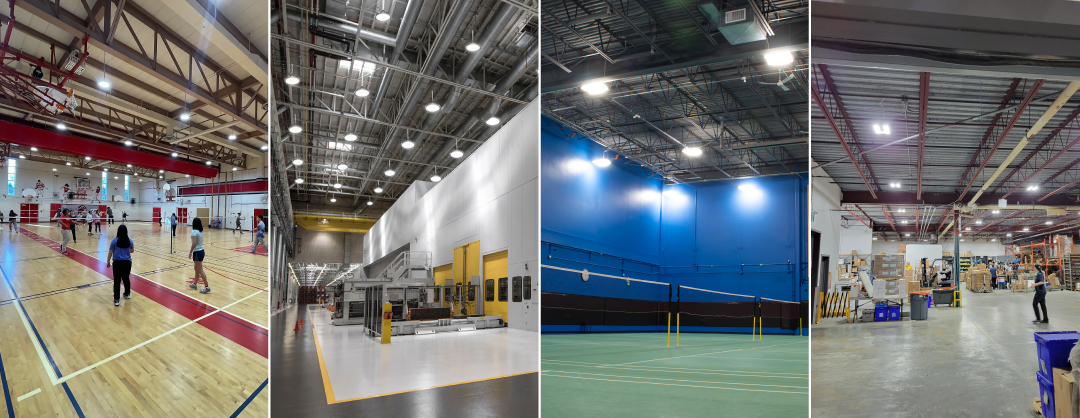
2. Mounting & Installation
Installation style can also influence your decision.
Round High Bays
Typically single-point mounting (hook or pendant)
No specific orientation required
Faster, more flexible installation
Linear High Bays
Usually dual-point chain mounting
Requires alignment
Often preferred for structured layouts (like aisles)
Both options can be adapted to:
Surface mounting
Pendant mounting
Choosing the Right Option for Your Space
With modern LED advancements, the decision is less about performance and more about application needs.
Choose a Round High Bay (HB8) if:
You need wet-location or washdown ratings
Installation flexibility is important
Your environment requires certifications (NSF, NEMA 4X)
Explore the HB8 High Bay for demanding environments.
Choose a Linear High Bay (LHB04) if:
Your space is dry and controlled
You prefer a traditional linear layout
You’re lighting aisles or organized floor plans
Explore the LHB04 Linear High Bay for efficient indoor lighting.
Final Thoughts
Many of the traditional differences between linear and round high bays—such as light distribution—are no longer limitations thanks to LED optics.
Today, the decision comes down to:
Environmental requirements
Mounting preferences
Layout and visual preference
Both styles offer high performance, efficiency, and flexibility—so choosing the right one is about matching the fixture to your space.
If you’re unsure which option is best for your project, our team can help you select the right solution with confidence.