

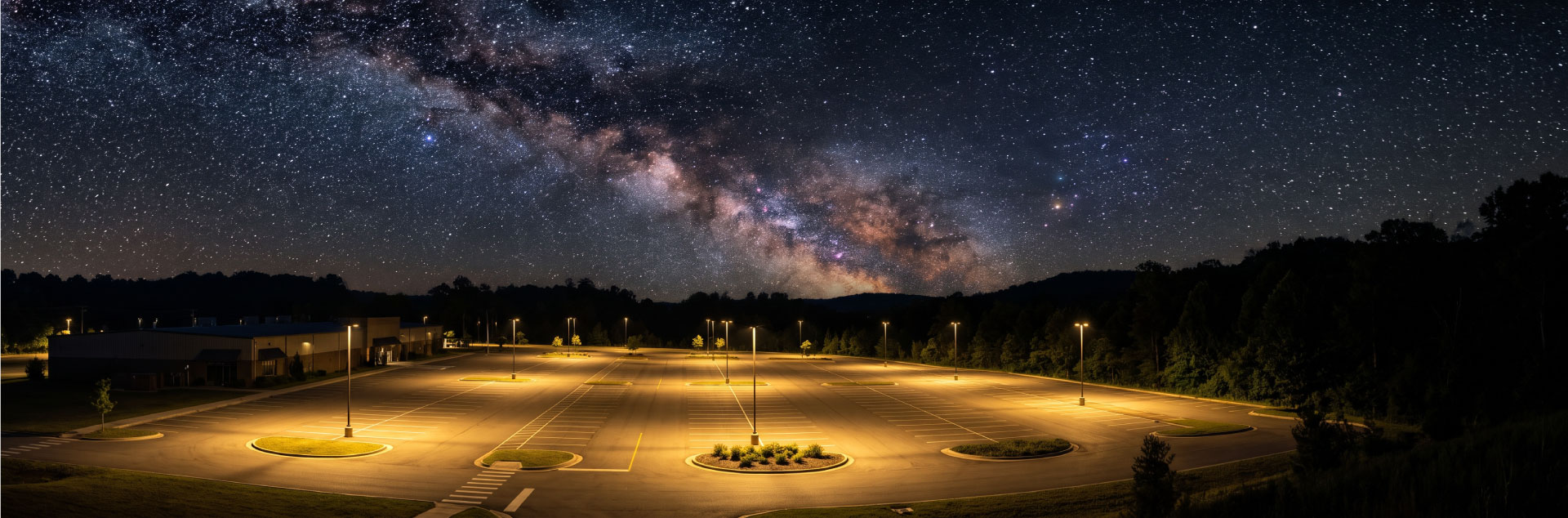
Navigating the Dark-Sky Shift
Navigating the Dark-Sky Shift:
How Canada’s Tightening Light Pollution Laws are Redefining Commercial Lighting
Across Canada, the rules governing exterior lighting are changing rapidly. For electrical contractors, engineers, and distributors, outdoor lighting is no longer just about safety, visibility, and aesthetics. Today, it is increasingly about containment, spectrum control, and strict legal compliance.
As municipalities across the country crack down on skyglow, glare, and light trespass, Dark-Sky compliance has evolved from a niche environmental design choice into a mandatory regulatory checkpoint.
Here is how the Dark-Sky movement is permanently reshaping the Canadian lighting industry, and exactly where the regulations are hitting the hardest.
The New Reality: Shielding, Shadows, and the Sub-3000K Mandate
The shift toward dark-sky preservation is changing the physical and technical specifications of modern outdoor fixtures. When layout designers and engineers build project submittals today, they are looking closely at two major requirements:
The Death of Cool White Outdoors: High-kelvin exterior lighting (4000K to 5000K) is rapidly being banned for outdoor use in commercial and municipal developments. Blue-rich light scatters more easily in the atmosphere, severely worsening skyglow. The new baseline standard across Canada is 3000K or lower, with many ecologically sensitive zones pushing for ultra-warm 2700K or 2200K limits.
Mandatory Zero-Uplight & Cutoff Optics: Unshielded floodlights, drop-lens wall packs, and decorative globes that throw light above the horizontal plane are being phased out by local bylaws. Projects now legally require full-cutoff luminaires. Fixtures must carry verified BUG (Backlight, Uplight, Glare) ratings proving that light is targeted strictly downward onto the designated property boundary.
Where the Rules Are Striking Hardest: A Province-by-Province Regulatory Guide
Because Canada does not have a single, unified federal "Dark Sky Law," enforcement is handled via an intricate mix of provincial park mandates, regional zoning overlays, municipal site-plan controls, and local nuisance bylaws.
The tables below provide the official regulatory links, major protected preserves, and localized "hot zones" where strict lighting rules are actively enforced.
1. British Columbia
In BC, light pollution enforcement is driven by eco-conscious coastal municipalities and communities bordering national parks, using strict development permits to dictate fixture design.
The Hot Spots: Vancouver, Tofino, Kelowna, and Whistler.
Region / Preserves | Primary Regulation Type | By-law & Regulatory Source |
Metro Vancouver | Urban Outdoor Lighting Design Codes | |
Vancouver Island (Tofino) | Eco-District Zoning & Full-Cutoff Mandates |
2. Alberta
Alberta features some of the largest wilderness Dark-Sky preserves in the world. Municipalities surrounding these parks enforce highly restrictive land-use bylaws to eliminate commercial light spill.
The Hot Spots: Foothills County, Smoky Lake, Jasper, and Bon Accord (Canada's first designated Dark Sky Community).
Region / Preserves | Primary Regulation Type | By-law & Regulatory Source |
Foothills County | Land Use Dark Sky Abatement Bylaws | |
Smoky Lake County | Regional Heritage & Ecological Zoning |
3. Saskatchewan
Saskatchewan focuses lighting restrictions within its major ecological reserves, utilizing strict multi-jurisdictional park agreements that bind municipal planning.
The Hot Spots: Cypress Hills and Grasslands National Park.
Region / Preserves | Primary Regulation Type | By-law & Regulatory Source |
Cypress Hills Interprovincial Park | Joint Alberta/Saskatchewan Lighting Accord |
4. Manitoba
Manitoba has formalized night-sky protection criteria through its provincial park system, actively promoting targeted amber lighting and strict dimming controls for adjacent developments.
The Hot Spots: Spruce Woods Provincial Park and surrounding rural municipalities.
Region / Preserves | Primary Regulation Type | By-law & Regulatory Source |
Spruce Woods Provincial Park | Provincial Park Light Pollution Mitigation Policy |
5. Ontario
Ontario is seeing an aggressive wave of municipal bylaws where light trespass across commercial property lines is classified as a fineable public nuisance.
The Hot Spots: Muskoka Lakes, Huntsville, Georgian Bluffs, Manitoulin Island, and Point Pelee.
Region / Preserves | Primary Regulation Type | By-law & Regulatory Source |
Muskoka Lakes District | Structural Light Trespass & Curfew By-laws | |
Town of Huntsville | Mandatory Retrofit-on-Replacement Rules | |
Georgian Bluffs | Site Plan Control & Environmental Indexing |
6. Quebec
Quebec enforces the strictest, most heavily regulated lighting laws in North America due to the Mont-Mégantic International Dark Sky Reserve, which legally regulates the exact light wavelengths permitted across entire regional counties.
The Hot Spots: Sherbrooke, RCM of Granit, RCM of Haut-Saint-François, and surrounding Eastern Townships.
Region / Preserves | Primary Regulation Type | By-law & Regulatory Source |
Mont-Mégantic Reserve | Cross-Municipal Legal Zoning Decrees |
7. New Brunswick
New Brunswick is home to an aggressive push to establish the world’s densest, contiguous dark sky corridor, forcing surrounding municipal chambers to rapidly draft lighting mitigation bylaws.
The Hot Spots: St. Martins, Fundy Coast, and Mount Carleton.
Region / Preserves | Primary Regulation Type | By-law & Regulatory Source |
Fundy National Park | RASC Dark-Sky Protection Protocols |
8. Nova Scotia
Nova Scotia municipalities are leading the East Coast in passing formal, dedicated Outdoor Light Pollution Bylaws that carry strict temperature restrictions.
The Hot Spots: Argyle, Yarmouth, and Kejimkujik.
Region / Preserves | Primary Regulation Type | By-law & Regulatory Source |
Municipality of Argyle | By-Law 43 Outdoor Illumination Restrictions | |
Town of Yarmouth | Direct Cutoff and Horizontal Alignment Rules |
9. Prince Edward Island
PEI leverages localized municipal bylaws and environmental zoning, particularly within communities neighbouring provincial parks and coastal ecosystems, to minimize artificial skyglow.
The Hot Spots: Cavendish, North Shore, and rural coastal developments.
Region / Preserves | Primary Regulation Type | By-law & Regulatory Source |
PEI Coastal Buffers | Federal and Regional Land-Use Guidelines |
10. Newfoundland and Labrador
Newfoundland and Labrador manages its lighting guidelines by anchoring them to its sweeping wilderness and national park boundaries, where any commercial expansion inside buffer zones is subject to rigorous full-cutoff audits.
The Hot Spots: Terra Nova National Park and surrounding regional districts.
Region / Preserves | Primary Regulation Type | By-law & Regulatory Source |
Terra Nova Region | RASC Ecological Nighttime Management Rules |
National Metrics & Engineering References
For projects that span multiple jurisdictions, or for engineering firms looking to model compliant local installations, the underlying technical baselines can be cross-referenced through national astronomical and lighting programs:
The Canadian Benchmark: Review the nationwide design and assessment criteria managed under the Royal Astronomical Society of Canada (RASC) Dark-Sky Sites Program.
The Hardware Standard: Check compliance definitions via the DarkSky International Approved Luminaire Guidelines, which outline global best practices for shielding and spectral limits.
How CSC LED Supports Our Partners
You do not have to navigate these complex regional variations alone. We focus on keeping our product catalogs up to date and adaptable, helping ensure your projects have the right building blocks to meet evolving municipal specifications:
3000K Stock Readiness: We offer an extensive range of commercial outdoor fixtures featuring dedicated 3000K options.
Dark-Sky Approved Series: Select product families are certified and Dark-Sky approved when set to 3000K and fitted with select accessories.
Shielding & Accessories: We stock Dark-Sky supported accessories, including, optics, visors, glare shields, motion sensors and photocells to help control light distribution.
Expert Layout Support: Our internal design team provides comprehensive lighting layout services, analyzing your specific project parameters to suggest the best, highly efficient lighting solutions for the space.
With dedicated corporate offices in British Columbia, Alberta, and Ontario, we maintain a local presence to stay closely aligned with market trends and keep our product offerings highly relevant across Canada.


